
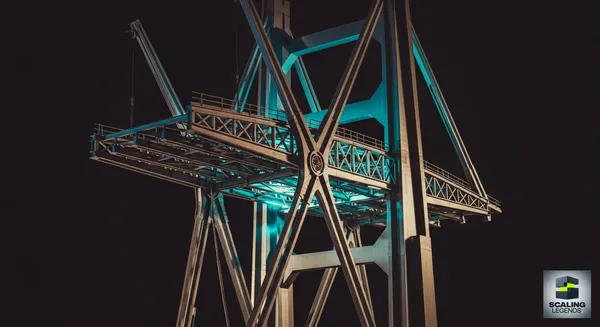

Maryland just drew the lines on the Key Bridge contracts and here is what matters: four packages, up to $4.8 billion, and the biggest one — a $3.5 to $4 billion design-build contract for the main span — goes to RFQ this summer. Kiewit is excluded. The field is open. If your company does major bridge work, approach roadway, or marine demolition, the clock started this week. We walk through every package, every timeline, and how to position your team before the RFQ drops.
Key Takeaways
-
Maryland Transportation Authority announced 4 Key Bridge procurement packages totaling $4B to $4. 8B
-
Package 1 — main span design-build: $3. 5B to $4B — RFQ opens THIS SUMMER, construction starts summer 2027
-
Package 2 — south land approach design-bid-build: $300M to $400M — bids invited fall 2026, construction spring 2027
-
Package 3 — north land approach design-bid-build: up to $300M — 2,400 feet approach bridge, retaining walls, roadway
-
Package 4 — demolition and marine: $50M to $100M — specialized marine contractor work, existing structure removal
-
Kiewit EXCLUDED from all new contracts — the primary incumbent is out; the field is completely open
-
Kiewit continues current contracted work through at least end of 2026 — no disruption to existing foundation work
The Numbers Behind Construction Business Growth 2026
Maryland Transportation Authority announced 4 Key Bridge procurement packages totaling $4B to $4. 8B
Package 1 — main span design-build: $3. 5B to $4B — RFQ opens THIS SUMMER, construction starts summer 2027
Package 2 — south land approach design-bid-build: $300M to $400M — bids invited fall 2026, construction spring 2027
Package 3 — north land approach design-bid-build: up to $300M — 2,400 feet approach bridge, retaining walls, roadway
Package 4 — demolition and marine: $50M to $100M — specialized marine contractor work, existing structure removal
What This Means for Contractors
Kiewit EXCLUDED from all new contracts — the primary incumbent is out; the field is completely open
Kiewit continues current contracted work through at least end of 2026 — no disruption to existing foundation work
Design is 70% complete — technical risk is lower than a typical design-build; you are finishing a nearly-designed bridge
Package 1 qualification requirements: major bridge experience, design-build delivery track record, bonding capacity for $3. 5B-$4B, strong financials
Packages 2 and 3 are realistic for mid-size contractors at $100M-$500M annual revenue — standard civil work with specialty components
How to Respond: Actionable Steps
Wetland ground improvement on Package 2 is a specialty requirement giving environmental and geotechnical contractors an edge
Teaming for Package 1: you need a bridge engineering design partner AND a marine contractor — start those conversations this week
MDTA virtual industry forum already held — register for procurement updates portal NOW to receive RFQ notification immediately when it releases
Summer 2026 is the critical window: RFQ for Package 1 releases within 60 to 90 days — team formation must happen before that
Smart Business Automator: tracking MDTA procurement releases and alerting when the Key Bridge RFQ drops so your team has maximum response time
Related Reading
- Construction Project Management: Surviving the Messy Middle
- 5 Cash Flow Mistakes That Kill Construction Companies
- How to Scale a Construction Business Without Losing Control
- The Contractor’s Guide to Project Workflow Automation
- Building Roads and Breaking Barriers: Ebony Jennings’ Construction Legacy
Market intelligence and data for this analysis provided by Smart Business Automator.
The Bottom Line
The data is clear: construction business growth 2026 is a critical issue for contractors in 2026. The businesses that act on this intelligence now will be positioned to capture market share while competitors are still reacting. Start with the key takeaways above and build from there.

The $6.7 Billion NJ Turnpike Bridge 2026: How One Governor Slashed $4 Billion From a Mega-Project and What Contractors Need to Know Before Prequalification Opens
Episode summary
New Jersey Governor Sherrill killed the original $10.7 billion twin-span bridge plan and cut it to a $6.7 billion single cable-stayed bridge. 19,000 construction jobs. Contractor prequalification opens summer 2026. This episode covers the project details, the procurement timeline, and how to position for the largest bridge project in the Northeast.
Read the full episode transcript
Usually when a state governor steps up to a podium to talk about an existing infrastructure project, there's a collective bracing for impact. Oh, absolutely. Right. I'm Justine, by the way. Welcome to this deep dive on Scaling Legends. And I'm Nicole. And yeah, that bracing for impact is real because, well, the unwritten rule of modern megaprojects is that the price tag really only moves in one direction. Up. Always up. Exactly. You just expect to hear about, like, supply chain delays or unexpected environmental reviews and just massive cost overruns. But consider this scenario for a second. A governor steps up. Officially kills a $10 .7 billion bridge project. And then in the same breath, announces a $6 .7 billion replacement. Which is just unheard of. Right.
Same location, serving the exact same traffic corridor on the New Jersey Turnpike. But somehow, $4 billion cheaper. And I mean, a $4 billion reduction isn't just finding extra change in the couch cushions. That is a fundamental rewriting of a project's reality. That kind of capital shift changes the entire risk profile for the state, for the contractors, and really the whole... regional economy. And that staggering pivot is exactly what we are getting into today. We're talking directly to you, whether you are a construction business owner trying to position your company for growth, or maybe a project manager battling daily site logistics. Or just someone who is fascinated by the sheer mechanics of a multi -billion dollar infrastructure. Exactly. We have a massive stack of sources today. We are analyzing
the official project announcements, parsing through the engineering design overviews, and looking at the raw market data regarding the Vincent R. Cassiano Memorial Bridge. Because the ripple effects of this single project are going to alter material supply lines and labor availability across the entire Northeast construction market for, honestly, the next decade. So our mission today is to break down the mechanics of this pivot. We're going to look at how a state actually slashes $4 billion without canceling the project, what the new engineering design means for the physical construction timeline, and crucially, How you need to maneuver right now to win a piece of the 19 ,000 jobs going up for bid. It's a massive pie. It really is. So let's unpack the financial pivot first. Right. So the original plan, which was backed by Governor Murphy, was
a $10 .7 billion twin -span bridge. Twin -span meaning two separate bridges. Exactly. The engineering called for two entirely separate massive structures built side by side. But recently, Governor Mikey Sherrill scrapped that twin -stand approach. Which was a huge announcement. Huge. And her administration's finalized plan is a $6 .7 billion single cable -stayed bridge. But the most critical financial mechanism here, the thing that dictates the rest of the project's behavior, is that it is entirely toll -funded. Okay, wait, let me push back on the optics of going from two bridges to one, though. Because on taper, it sounds like... Going to a dealership to buy two SUVs for your corporate fleet, realizing you don't have the budget, and driving off with one massive commercial
bus just to claim you saved money. That's a funny way to picture it, but I get the concern. For like, are we sacrificing capacity just to hit a political budget goal? We have to look at both sides of this objectively. Impartially, yeah. But looking at the actual engineering schematics, the capacity is completely preserved. Oh, really? Yeah. The single span accommodates four lanes of active traffic, so it maintains the necessary throughput for that specific corridor of the turnpike. It actually remains one of the largest single -bridge projects in the Northeast under the IIJ era. The Infrastructure Investment and Jobs Act. Right. So where do the savings come from? They're derived from stripping out physical redundancy. According to Smart Business Automator's market intelligence report, eliminating that second bridge completely removes the need for
duplicate concrete piers, duplicate steel superstructures, and of course, the redundant labor hours required to assemble them side by side. Okay, that makes sense. You're just not building everything twice. Exactly. But you also mentioned the toll funding mechanism dictating the project's behavior. Relying entirely on turnpike tolls means there is like... Zero federal funding involved in this $6 .7 billion package. Zero. And avoiding federal dollars changes the entire procurement timeline. How so? Well, when a state accepts federal highway funding, they trigger this massive cascade of mandatory federal oversight. The red tape. So much red tape. The most significant is the NAPA process, the National Environmental Policy Act. I've heard of that being a huge bottleneck. It is. A project
of this magnitude would require an exhaustive environmental impact statement, and that has to be reviewed by multiple federal agencies. We're talking everyone from the EPA to the Army Corps of Engineers. That sounds like a nightmare to coordinate. It's notoriously slow. That interagency review process can stall a project in the administrative phase for three to five years before or a single shovel even hits the dirt. Wow. Five years of just paperwork. So by funding it entirely in -house through tolls, the state basically regains total control over the calendar. Exactly. They aren't waiting on a federal desk in Washington to, you know, stamp environmental review. Right. They bypass that specific layer of federal bureaucracy. Now, to be clear... they still must meet stringent
state environmental standards. Yeah, New Jersey has its own rules. Absolutely. But the review process is localized and significantly more streamlined. This localized control is really the primary reason the state can confidently accelerate the procurement timeline. Okay, but the calendar acceleration is also tied to the physical architecture of the bridge itself. Yes, it's a huge factor. So we are moving from the finances to the physics here. The new design is a cable -stayed bridge, which is a massive departure from a traditional multi -pier design spanning a river. It's completely different. For those trying to visualize it, a cable -stayed bridge features these towering vertical pylons with massive tensioned cables angling down directly to the bridge deck to support the load. It basically looks like a giant harp. Yes, exactly like a giant harp. And the traditional
twin -span design that was scrapped... That would have required numerous concrete piers spaced relatively closely together all the way across the water. Which is incredibly hard to build. Very. A cable stay design relies on tension and those massive central support towers, meaning it requires a fraction of the piers in the water. I always think of traditional underwater foundation work like... Trying to pour a concrete basement for a house while someone is aggressively spraying a high -pressure fire hose into the trench? That is painfully accurate. Right. You are battling constant river currents, tidal shifts, and basically zero visibility. The fire hose analogy perfectly illustrates the friction of marine construction. Building a bridge pier requires driving sheet
pile into the riverbed to create what's called a cofferdam. Like a temporary wall to keep the water out. Right. Then you have to pump the water out. and excavate the mud all the way down to solid bedrock. It's exhausting. It is. You are constantly fighting water pressure, sediment collapse, and just the unpredictable geology of the riverbed itself. You might hit a massive boulder that the soil samples completely missed. Or the current just changes on you. Exactly. You can experience severe scour where the current literally washes away the sediment around your piles. Underwater construction is arguably the single largest variable in civil engineering. But balancing a massive bridge deck on tension steel cables attached to a 400 -foot tower in the air is also, you know, highly complex engineering.
Oh, without a doubt. So are we just trading the unpredictability of the river? for the unpredictability of wind shear and load balancing? That's a fair question. The distinction really lies in predictability. Okay, explain that. Wind shear, structural resonance, tensile strength, these are incredibly complex calculations, but they are mathematical constants. Engineers can model them with incredible precision using modern software. Whereas a riverbed is just doing whatever it wants. Exactly. Riverbeds are volatile and dynamic. By pulling the bulk of the engineering up out of the water and into the air via the cable -stayed the project sheds its most unpredictable variable. So the state can actually map out a construction schedule with a much higher degree of certainty. Precisely. And that certainty is what allows them to target a phased construction approach. The sources show
an initial traffic shift is slated for 2031. Which is very aggressive for a mega project. Because the state is sidestepping the federal NEPA delays and utilizing a faster physical design. The starting gun for contractors has already been fired. The timeline is compressing rapidly. We're talking about 19 ,000 construction jobs attached to this single project. Contractor pre -qualification officially opens in summer 2026 via the NJTA website. Which sounds like a long time from now, but in construction years, it's tomorrow. Right. Let's look at the actual requirements. To even submit a bid, a contractor must demonstrate an impeccable safety record, provide audited financial statements, produce a massive bonding capacity letter, and prove mandatory project labor agreement compliance. It's a gauntlet.
It is. So if I run a large regional concrete outfit, Why does the guidance suggest I need to start overhauling my administration right now? Summer 2026 is still a little ways out. Because meeting the threshold for a mega project requires systemic proof of competence. It's not just a form you fill out. Give me an example. Let's look at the safety requirement. The state will heavily scrutinize your EMR or experience modification rate. That's the insurance metric. Yes. It's a metric calculated by insurance companies comparing your company's workers' compensation claims against the industry average. A baseline average is 1 .0. Okay. If you've had a few recent sight injuries and your EMR creeps up to, say, 1 .2, you are mathematically deemed a higher risk. And that hurts your bid. It can kill your
bid entirely. And lowering an EMR takes years of logged, incident -free labor hours. You cannot fix a bad safety record three months before a bid. Wow. Okay. And I imagine the financial scrutiny is just as intense. Gathering audited financial statements isn't just about, you know, printing out last year's tax returns and some profit and loss sheets. Not even close. For a project scaling into the billions, surety companies. These are the entities that provide the construction bonds, guaranteeing the project will be finished even if the contractor goes bankrupt. They will perform a forensic audit of your liquidity. They want to know you can survive the cash flow gap. Exactly. They look at your debt to equity ratio, your working capital, and your cash flow projections. They are stress testing your company's ability
to float payroll for hundreds of workers if a payment from the state is delayed by 60 days. Which happens all the time. All the time. Securing a bonding capacity letter at this scale is a months -long negotiation. Then there is the Project Labor Agreement, or PLA, compliance. If I'm a contractor who typically operates non -union, bidding on a PLA project represents a massive operational pivot. It's a total overhaul. A project labor agreement is basically a pre -hire collective bargaining agreement that establishes the terms and conditions of employment for a specific construction project. So you have to play by their rules. Right. It mandates union -level wage rates, standardizes shift times, dictates exactly how overtime is calculated, and establishes strict pre -negotiated
dispute resolution protocols. So if my HR department isn't used to that, you're in trouble. Adapting your HR, your payroll software, and your hiring practices to ensure seamless PLA compliance requires intense legal and administrative preparation. So the state is essentially demanding that contractors spend the next several months proving they simply have the operational maturity to even step up to the starting line. Exactly. Missing a single spec on a PLA audit or having a slight gap in your liquidity ratios means your bid goes straight into the shredder. Which brings us to a major vulnerability for mid to large contractors trying to scale into this tier. The sheer volume of paperwork and compliance acts as a massive bottleneck. Oh, administration is where margins are actively destroyed on modern construction sites. It's
funny because we often view construction through a purely physical lens, right? Like cranes lifting steel, excavators moving earth. The glamorous stuff. Yeah. But our sources detail how the physical progress of a $6 .7 billion bridge is entirely tethered to a digital backbone. 100%. And the current industry standard is shifting toward AI platforms to manage this load. Specifically, there is a tool mentioned called Smart Business Automator. Right. Because a delay on the physical job site is almost never an isolated incident of machinery breaking down or a crew just working slowly. No. No. The root cause of a physical delay typically starts three weeks earlier in an administrative inbox. Walk me through the mechanics of that. How does an inbox stall a concrete pour? Okay, imagine a structural engineering
firm issues an addendum, right? And it alters the spacing requirements for the rebar inside a specific bridge pier. Happens all the time. Right. But that change is documented on page 400 of a... dense, highly technical PDF. Oh no. Yeah. The project manager, who was already managing three other crises that morning, misses the email or just skims past the detail. So they don't update the crew. Exactly. The rebar is tied according to the old spec, the concrete truck arrives, and the material is poured. Two days later, a state inspector reviews the physical work against the updated addendum and fails the pour. Ouch. So now you have to mobilize a demolition crew to rip out fresh concrete, reorder the new rebar, and reschedule the concrete trucks. You're losing, what, three weeks of the schedule? At least. And all because a single line of text in a PDF
went unnoticed. That is terrifying for a project manager. Which is why contractors scaling up to manage these 19 ,000 job projects are integrating AI. Smart Business Automator's Market Intelligence Report highlights how modern document intelligence works here. How does it fix that PDF problem? An AI platform ingests that 500 -page PDF addendum, uses optical character recognition and natural language processing to extract the specific rebar spec change, cross -references it with the existing purchase orders and daily schedules, and automatically flags the discrepancy to the project manager. Wow. So the software catches the data variants before the purchase order for the wrong material is even sent? Exactly. It acts as an automated risk detection layer. It also integrates directly via API with a contractor's ERP, their enterprise
resource planning system. Which is like the central nervous system of a large company. Right. Linking payroll, accounting, inventory. When field superintendents submit messy, unstructured daily reports from the job site, the AI parses that field data. categorizes it, and feeds clean, structured data directly into the ERP. So instead of a project manager spending four hours every evening manually typing up field notes and cross -referencing change orders, the system organizes the data flow for them. Yes. That frees the project manager to actually manage the logistics of the site, rather than acting as a glorified data entry clerk. And on a project with zero tolerance for pre -qualification errors and a highly accelerated physical timeline, administrative clarity is definitely not a luxury. No, it is a hard operational
requirement to keep the physical trucks moving. We have analyzed the mechanics of the $4 billion budget cut, the engineering shift away from the unpredictability of the riverbed, the intense reality of the 2026 pre -qualification sprint, and the AI required to manage the massive data load. That's a lot to take in. It is. But let's apply the sheer scale of the Cassiano Bridge to your immediate reality as a listener, regardless of whether your specific company intends to bid on a single turnpike contract. This is the crucial part. When a state initiates a $6 .7 billion project, it fundamentally alters the macroeconomic landscape of the entire region. Think about the mechanical impact. of suddenly opening a massive, high -paying manufacturing plant in a medium
-sized town. Right. Every other local business suddenly struggles to find workers because everyone is applying to the new plant. Exactly. The Cassiano Bridge will act as a massive resource vacuum. 19 ,000 jobs require tens of thousands of electricians, iron workers, heavy equipment operators, and logistics coordinators. Plus the materials. Oh, the materials. The state will be purchasing concrete, steel, and heavy machinery at an unprecedented volume. So if you are a mid -sized commercial contractor building, say, a high -rise office complex two states away, your local labor pool will shrink as workers migrate toward the guaranteed union wages of the Turnpike project. Which means you will likely face wage -bidding wars just to retain your own framing crews. And your material lead times for specialized steel might extend
from four weeks to 12 weeks. Because the supply chain only has so much elasticity. A project of this magnitude stretches the entire Northeast construction network to its absolute limit. So you must adjust your future project bids, your timeline estimates, and your material procurement strategies right now to account for the incoming resource scarcity. Preparation is everything. It is a massive disruption. But with disruption comes incredible opportunity for those who understand the mechanics of the shift. A governor cut $4 billion from a budget and in doing so accelerated a timeline that will reshape the regional economy for the next 10 years. The starting gun has fired. And the window to prepare your administration, your safety records, and your supply chains is closing quickly. If you know a contractor who is dealing with mega project prequalification,
send them this deep dive. It could be the edge they need to get their documentation right before the window opens. Hit follow on whatever app you're listening on so you don't miss tomorrow's intel. And be sure to visit smartbusinessautomator .com. Because the preparation you implement today dictates the scale you can achieve tomorrow. Keep building, keep refining your processes, and we will catch you on the next one.
Put what you learn into practice. Get a free workflow assessment.